

The most dangerous moment in any crisis is not day 30. It’s hour 1.
In that first hour, leaders are tempted to do one of two things:
Both responses are costly. Research shows that organizations that respond quickly and clearly in a crisis are far more likely to maintain trust and recover faster than those that delay.
You don’t need to predict every twist of the crisis on day one. You just need a simple, repeatable playbook for the first 24 hours.
This is your agility test.
Across my executive search and coaching work, I’ve watched senior leaders under pressure in product failures, supply chain collapses, sudden resignations, cyber incidents, and public scandals.
The pattern is always the same:
Their teams feel the difference immediately. Studies of crisis leadership show that when leaders take structured, task‑oriented action early, clarifying priorities, stabilizing operations, and communicating what comes next, people perceive the environment as safer and engage more effectively in solving problems.
In other words, in a crisis, leadership “presence” isn’t about charisma. It’s about structure and humanity, delivered fast.
Let’s turn that into a 24‑hour playbook you can keep on your desk for the next shock—because there will be a next one.
Think in three phases: 1–2 hours, 2–6 hours, and 6–24 hours.
You won’t get everything right. But if you get these nine moves mostly right, you will stabilize the system enough to make better decisions on day two.
Your only job in the first two hours is to protect people, contain damage, and take charge—even if you don’t have all the answers.
You can fix processes later. You can’t undo harm.
Empirical work on crisis teams shows that nested decision loops—frontline data feeding into leadership, and leadership feeding clear decisions back—support faster, more coherent responses.
In a shock, ambiguity about “who is in charge” is like pouring fuel on the fire.
You won’t have perfect information, but you must align on “what we know for now”:
Write this on one page. It becomes your temporary “truth” that you will keep updating.
Once you’ve stopped the immediate bleeding, shift to stabilizing the system and shaping the narrative—for your people first.
Research consistently shows that the way leaders communicate in the first hours of a crisis shapes trust more than the incident itself.
Your people are asking three questions:
Your first internal message should:
Honest, empathetic communication—delivered consistently—is one of the strongest predictors of team morale and public perception in crisis.
You cannot fix everything in the first day. Leaders who try end up doing nothing well.
Evidence from crisis leadership in complex environments shows that short‑term planning, clarified objectives, and decisive problem‑solving are exactly the “initiating structure” behaviors that improve safety and performance under pressure.
Ask your crisis team:
Turn this into 3–5 concrete actions with owners and deadlines. This is where proactive agility starts to show up: not in predicting everything, but in prioritizing well under uncertainty.
Even in a crisis, leadership isn’t one‑way.
Studies of remote and crisis work find that leaders who demonstrate consideration, listen, acknowledge concerns, and remain emotionally aware mitigate negative impacts and keep people engaged.
So, alongside your clear direction, you also:
You’re not promising to fix everything instantly. You’re signaling: “We see you. We’re listening. Your input matters to how we respond.”
Now you move from “reaction” to “organized response.”
Depending on the crisis, this may include regulators, emergency services, suppliers, landlords, or community partners.
Effective crisis responses often involve coordination with external agencies and sharing situational reports so resources can be aligned and support can be mobilized.
You also need to decide:
Mixed messages create secondary crises.
In the moment, documentation can feel like bureaucracy. In reality, it’s your memory when things get chaotic.
Best‑practice crisis playbooks recommend logging key decisions, rationales, and communications from the first hours.
This serves three purposes:
Agile organizations don’t just “get through” crises. They mine them for design improvements.
Before the first 24 hours end, gather your crisis team again and ask:
Research on crisis decision‑making emphasizes scenario‑based thinking: build best‑, base‑, and worst‑case views, use the data you have, and be willing to adapt as new information emerges.
You don’t need a perfect long‑term plan, but you do need a credible, flexible outline that your people can see.
This is where you transition from “shock management” to “strategic recovery.”
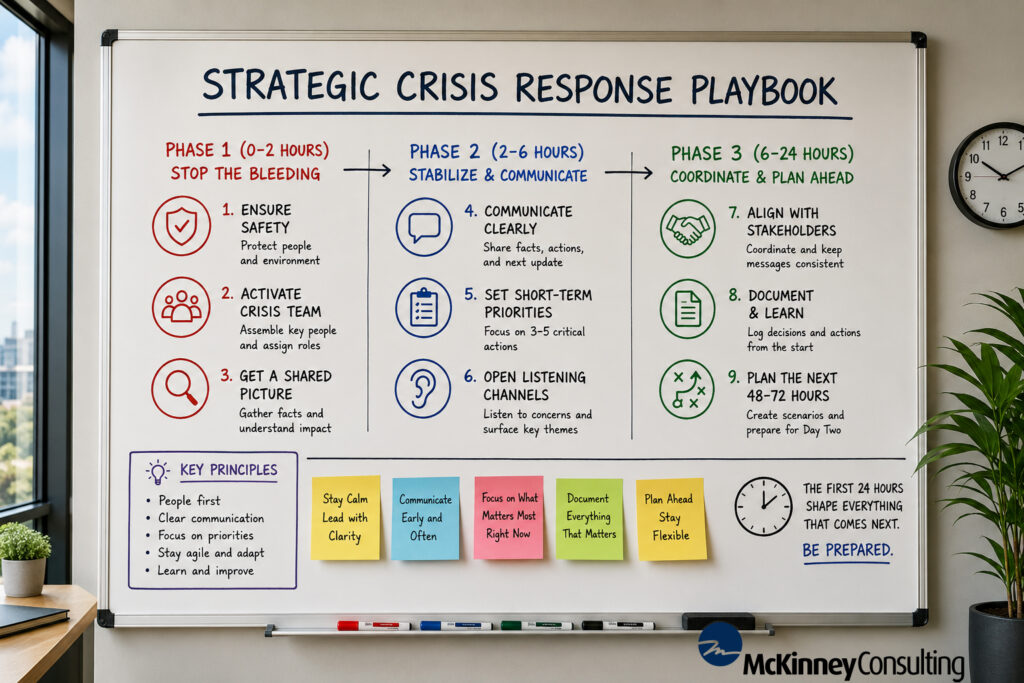
When I look at leaders who navigate crises well, they share a handful of habits that you can adopt before the next shock arrives:
That’s what I call Proactive Agility in crisis: not predicting the exact event, but designing your response capabilities in advance so that when the shock comes, you move with confidence instead of panic.
You can turn this newsletter into a practical asset for your organization in the next 30 minutes.
Here’s a simple exercise:
If you’d like a one‑page “First 24 Hours” checklist you can adapt and use with your team send me a direct message, I’m happy to share a version you can customize for your organization.
Because in a crisis, you don’t rise to the occasion. You fall to the level of your preparation.