There are multiple reasons why perfect leaders make imperfect hiring decisions. I will identify the top three hiring decision mistakes and some professionally proven strategies to improve the process. These strategies implemented correctly are guaranteed to improve your performance.
I am not suggesting that I am perfect in recruiting and that you are not. However, I have led an executive search firm for over 20 years. And I have a performance track record that exceeds the industry norm. We provide executive search services from small companies to large Fortune 100 clients, locally and globally through our global network of partners. We follow best practices and have developed a pattern of success. Here are 3 top reasons why perfect people make imperfect hiring decisions.
When it comes to recruitment, many decision-makers unconsciously hire people like themselves. Even though their intentions are admirable, the results are often less than desired. Personal biases can creep into the process without us even noticing them. It is a common mistake. Also, some managers believe they have a monopoly on how others should act and be at work. However, the reality is that our organization needs a variety of multi-skilled players. Think about the skill sets of a professional baseball team.
There are nine different position players on the defensive side of the playing field. Each of these positions in baseball requires a unique set of talents and strengths specific to their role. No two are alike, though some could have similar skill sets. The goal is not to have every player with the same characteristics. The goal is to identify the specific skills needed for each role and then identify the players who possess the required skills.
Baseball provides an excellent analogy for this point. If you are not super clear on what position the new hire will play on your team, the odds are you will make a poor hiring decision.
Furthermore, too much focus on the job description versus the basic skills required to succeed in the role will result in a hiring failure. Skills-based hiring is critical to success. Check out my article, How To Win The War For Talent By Skills-Based Hiring.
Consider the candidate's growth potential coupled with the short and long-term vision of the position. Too often, hiring managers focus only on what they need today. However, if one only thinks about short-term objectives in hiring, she could miss the opportunity for long-term success. For example, candidates may ask what the growth potential for this position is? And, what is the hiring companies' vision for the future? Are the company and industry trending up or down?
If the hired candidate can do the role today and has the potential to step up later, he'll probably make a good hire. What if he does not have the growth potential, but he can do the job today? What will you do with him in a few years? Will you have to conduct a new search? What's the cost of having a seat vacant a work?
Case study: Our client is a well-known global logistics company. The client hired us to identify and place a Chief Financial Officer (CFO) candidate. One special request made this executive search a proper skills-based hiring mandate, with a short-term and long-term component.
The client needed our candidates to be a CFO immediately and have the growth potential to take on the CEO role within three years. We succeeded in finding the right fit candidate. The successful candidate excelled and moved into the CEO suite in less than three years.
I want to suggest that you adopt these three improvement actions to your hiring plans. By doing so, I believe that you will improve the imperfect hiring process by having tremendous hiring success.
There are more tips than these that I could share about why do perfect leaders make imperfect hiring decisions. But I believe these are three directions are enormous and impactful in hiring.
In conclusion, if you read about building muscles, your muscles will not grow. Only after you apply the exercises suggested will your muscles grow. Improving your hiring skills will take more than reading this blog post. However, if you implement the ideas you have read today, you will become a successful hiring decision-maker.
Recently, much has been written about corporate culture, hybrid workforce, and flexible work hours. Changes in the workplace and how we physically are here to stay. A combination of sitting, standing, and walking effectively improves health.
For example, some companies will increase salaries to win the war for talent. In the U.S.A., recent research has shown that year-to-date salary increases will nearly double in 2022. Interestingly, the historical norm is an increase of 2%.
Also, the Conference Board, a New York-based think tank, indicates we’ll have the highest increase since 2008 this year. They predict a 3.9% increase in wage costs for firms, which includes pay for new hires. However, some companies that cannot increase wages reduce hours by implementing a 32-hour workweek with the same compensation.
Another effective technique in recruitment is skills-based hiring. Human resource leaders and other hiring decision-makers are beginning to change their assessment methods in hiring talent. Instead of putting so much weight on university degrees, more emphasis is on what precisely a candidate can do for our organization today.
How do we physically accomplish our daily tasks with these organizational changes? The physical location, workplace environment (corporate culture), and work hours are critical to productivity. But there’s more.
As we hire better and provide various venues (office, home, on the beach, etc.) to work from, it is also imperative that we address how we physically work. Our productivity and workplace satisfaction will suffer if our physical condition goes unchecked.
In this post, we will dive deeper into exactly how we physically work. Too much sitting is bad for our health. A combination of sitting, standing, and walking effectively improves health. And is the best way to accomplish our work. I feel a slight vibration on my wrist. I look down at my watch and see a colorful character stretching with the caption “Time to get moving!”
First, let’s cover the most used method for work or study, sitting at a desk. The dictionary definition of sitting is a bit humorous. According to Webster’s Dictionary, one purpose is “To rest on the buttocks.” In the U.S. military, they say, “Take seats.”
We have sat at work for many years and have been able to focus and be productive. However, there are problems with excessive sitting. The U.K. Chief Medical Officers’ Physical Activity Guidelines report recommends breaking up long periods of sitting time with activity for just 1 to 2 minutes. While historically, knowledge workers have sat on their buttocks to work, this practice has some health concerns. Mayo Clinic Research indicates links between sitting for long periods with several health concerns. Problems include obesity and increased blood pressure, high blood sugar and excess body fat around the waist, and abnormal cholesterol levels. Too much sitting overall and prolonged periods of sitting also seem to increase the risk of death from cardiovascular disease and cancer. Shorter sitting spells improve health.
So, if we must sit to work, here are a few practical tips to minimize the health concerns with sitting. There is no single body position that is preferred for sitting. Occasional changes in seat positions can be beneficial. Here are some tips from the Canadian Centre for Occupational Health and Safety.
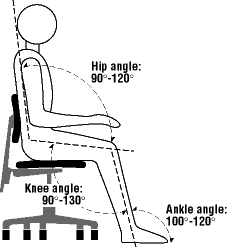
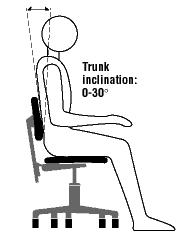
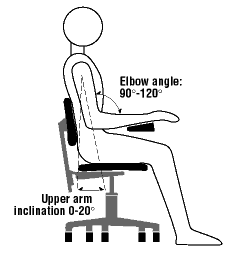
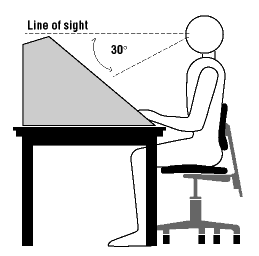
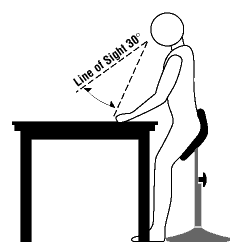
Alternatively, standing while working seems to provide excellent physical benefits. However, some studies have shown that there can be some adverse effects if one stands too long in the same position. These effects are sore feet, swelling of the legs, varicose veins, general muscle fatigue—low back pain, stiffness in the neck and shoulders, etc.
Workers can reduce comfort from sitting too much by standing for some of their work. Here are a few tips to consider:
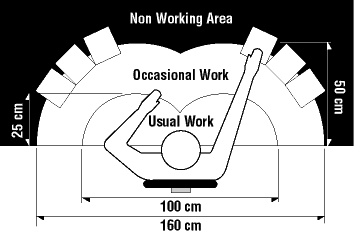
Finally, how about walking while you work? You know that you can sit and stand to work. How about walking? Well, we know that standing takes more energy than sitting. And walking takes more energy than standing. But can we walk and work all day? All the studies that I have read say no.
We know from various research that sitting at your desk all day is terrible for your health. Standing at your workstation for about 15 minutes out of an hour is recommended. Alternatively, a professor at the University of Waterloo suggests standing at least 30 minutes out of an hour. So, standing from 15 to 30 minutes during an hour seems to be the sweet spot. But how about walking for a portion of your sitting time?
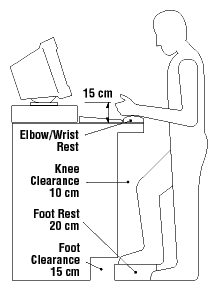
In a 2007 study, James Levine, from the Mayo Clinic’s campus in Scottsdale, Arizona, found that standing and walking at a treadmill desk while working can burn about 100 calories an hour more than sitting. He further revealed in March 2015 that over 12 months, participants increased their activity and lost weight. There were other health benefits, including lower cholesterol and triglycerides.
According to Jody Ensman, manager of the Health & Wellness program in the University of Kentucky’s H.R. Department “There are always risks in any physical movement and exercise.” She added, however, that treadmill-desk workstations are safe “as safe as any treadmill workout.” Her department provides some commonsense rules:
As your coworker has informed you from the lofty heights of their standing desk, sitting all day makes us sicker, fatter, and sluggish.
Research has shown that there are cognitive benefits to movement. More than 80% of people who participated in a 2014 Stanford University study “improved their creative output while walking.” Study participants who walked prior to solving a puzzle generated more creative solutions than sedentary participants and were better “divergent thinkers.” They examined the creativity levels of people while they walked versus while they sat. Also, a person’s creative output increased by an average of 60% when walking.
Julia Berman in SmartMeeting.com provides some exciting tips in this article entitled “How to Plan Your Walking Meeting.” I’ll list the 5 Main Benefits that she provides below. However, I suggest you read her article if you are serious about adding a walking meeting to your work regime.
Sitting with the correct posture is acceptable for work. However, if sitting at work is combined with 15 to 30 minutes in a standing position, it is even better. Finally, the best scenario is a combination of sitting, standing, and walking. Save your back.
5 min readToday, we often compare ourselves to others. Compare yourself with who you were yesterday. We see rich, famous, good-looking, and successful people, and we want to be like them. The problem is this could be superficial thinking and counterproductive to our progression in life. There are eight or more dimensions to our lives.
We are unique individuals, and there is no one just like us. When we compare ourselves to others, we often see only one dimension of their life. However, there are eight or more dimensions to our lives. And there is something that you can do today that can make you slightly better tomorrow.
Jordon Peterson noted clinical psychologist suggests that you should "Compare yourself with who you were yesterday, not to who someone else is today."
Firstly, no two individuals are exactly alike. Science proves that no two individuals are alike. There are variations in the DNA due to the Crossing-over and Recombination during the DNA copying process.
A good example is identical twins. Even though you have trouble telling them apart, they have individual differences. Your identity is who you are and the characteristics that define you.
On the inside, each person has their thoughts, ideas, interests, hopes, and fears. And our tastes or choices are essential. So, you should not make your decisions lightly. The sum of these choices determines who we are and who we will become.
Also, the multiple choices we make to learn, experience, and develop as a person shape and mold us into what we want to be. Thus, each person is unique, memorable, and different from everyone else. Therefore, why would we want to be like someone else?
Secondly, when we desire to be like someone else, we usually only see one dimension of their life. Yet, we have eight or more dimensions to our lives. A singularity view is not a complete picture of a person.
For example, author Michael Hyatt has a method of identifying the multiple dimensions of our lives. He describes the "10 Domains of Life in his Full Focus Planner." I use his methodology in determining the dimensions of my life, and I have found it to be immensely helpful.
His ten domains (dimensions of life) are as the following:
Spiritual Parental Intellectual Social Emotional
Vocational Physical Avocational Marital Financial
As you can see, our lives are multidimensional. There are eight or more dimensions to our lives. And while you might recognize that someone has excelled in one dimension of their life, you might not be aware that they have failed in one to seven other areas.
So, instead of comparing yourself with someone else, consider comparing yourself to who you were yesterday. An effective way to start is to do a self-assessment on where you feel you are in each domain of your life today.
Here is just one example of a Life Wheel tool. You will notice this example has eight domains, not ten. You should choose which seven to ten fields you want to use to describe your life. Once you have completed that task, measure yourself on a scale of one to ten, with one being the lowest and ten being the highest score for each domain.
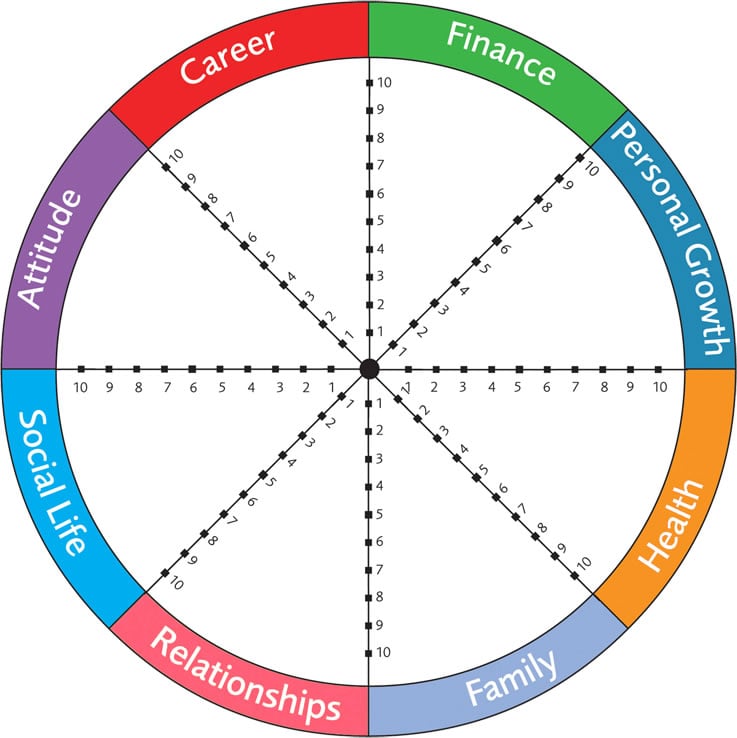
Your current focus will be evident after plotting your scores on the wheel. And you will identify the domains that need more attention. Also, note that it is normal for your priorities to change from time to time.
For example, when I was doing my undergraduate studies, my daily schedule was from seven a.m. until midnight every day. Humbly and with gratitude, I report that I was on a full music scholarship. However, I still had to do student loans to cover my living expenses. To minimize the student loan amount, I worked part-time 15 hours a week.
So, I would score myself a nine or ten on intellectual and vocational domains while in school. My Intellectual and vocational domains were my highest priorities at the time.
Also, for my financial domain, I scored myself a 4 or 5. I chose these numbers because I did all I could physically to earn an education while incurring the least debt. Had I chosen only student loans and no part-time work, I would have scored myself lower.
Now, how you score yourself on your domains is up to you. After plotting where you are on the Life Balance Wheel, make the necessary adjustments in your daily routine.
Thirdly, there is a simple truth that there is something that you can do today that can make you slightly better tomorrow. One way to become better is to consider making incremental changes.
In a previous article entitled How an Improvement Strategy is More Successful Than Goal Design I discuss incremental change. I share the success story of Sir Dave Brailsford and the UK Olympic Cycling Team.
Sir Brailsford committed to a strategy he referred to as "the aggregation of marginal gains." Brailsford said, "The whole principle came from the idea that if you broke down everything you could think of that goes into riding a bike and then improve it by 1 percent, you will get a significant increase when you put them all together."
I propose that you look at your domain scores from your Life Wheel Assessment. Then, prioritize which domains of your life you need to increase first, based on your current situation. There are eight to more dimensions to our life. If you took just one of your ten domains and were able to increase your score by one this month, you would have a 1% increase.
However, it is unreasonable to think that you can make improvements in all domains of your life simultaneously. But, over one year, it is possible. Only two to three fields will need a lot of attention. There is an interesting connection between this belief and the Pareto Principle.
The Pareto principle states that 80% of consequences come from 20% of causes (the "vital few") for many outcomes. For example, if 20% of car design flaws lead to 80% of crashes, you can identify and fix those flaws. Similarly, suppose 20% of your customers are driving 80% of your sales. In that case, you may want to focus on those customers and reward them for their loyalty.
We are unique individuals, and there is no one just like us. And our lives are not singular but multidimensional. There are eight or more dimensions to our life. However, we can do something today through the aggregation of marginal gains that will help us become better tomorrow. As Jordon Peterson suggests, "Compare yourself with who you were yesterday, not to who someone else is today."
Listening With the Intent to Understand, Not Reply
The Top Three Corporate-Culture Focus Areas for 2022 and Beyond
Why Ethical Behavior is More Profitable and Energizes Employee Engagement
How To Win The War For Talent By Skills-Based Hiring
3 min readOne major mistake most people make is not listening well. Leo Rosten said, “Why did God give me two ears and one mouth? So that I would talk less and hear more.” If we’re honest with ourselves, we all probably talk more than we listen.
Also, I believe that Author Stephen R. Covey gets to the real heart of the matter. He said, “Most people do not listen with the intent to understand; they listen with the intent to reply.” So, it would befit us all to increase our listening to speaking percentage.
Therefore, we should be concerned with improving our listening skills. Interestingly, research indicates that one can improve productivity by having good listening skills. And if we add improved listening skills with greater productivity, our ability to influence others and be more persuasive increases.
For example, listening with intent for international business people is crucial to their success. One cannot downplay the nuances of each country’s culture and its impact on effective communication.
Without understanding the other’s perspective and culture, it’s hard to communicate effectively. Thus. knowing your audience is key to effectively sharing information across different cultures.
For instance, outstanding behavioral psychologists have studied the world’s cultures. These professionals have gained insight by listening to how people from different countries think and communicate.
It’s complicated enough to understand and communicate with people from your own culture. Communication becomes more complicated when you add a person from a different culture into the conversation. So, learn as much knowledge as possible on whom you will be communicating. Then listen to understand, not just with the intent to reply.
If you are wondering, where can I learn about different cultures? Look no further. A handful of cross-cultural experts have done extensive work in this field. The most notable ones are:
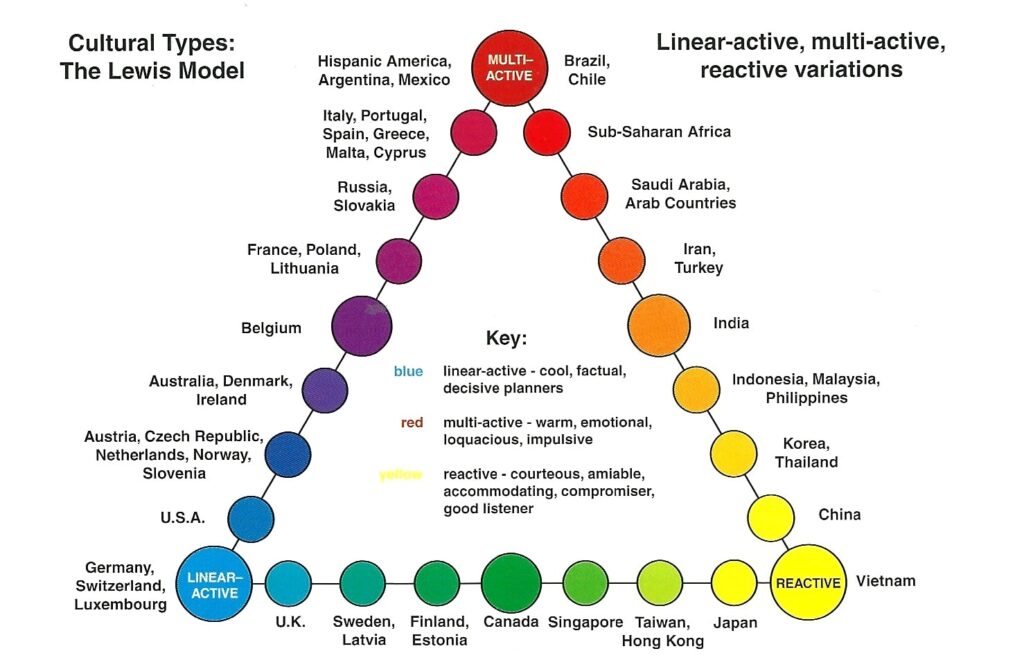
So, by studying how people think and react, we can improve our listening skills which improve productivity and increase our persuasive skills in making our point. Also, James Cash Penny said, “The art of effective listening is essential to clear communication, and clear communication is necessary to management success.”
To develop good listening skills, one should adopt good listening etiquette. Here are three ideas to consider.
First, if you don’t understand something that has been said, try paraphrasing. Repeat back to the speaker what you think that you heard and confirm that it is correct. By paraphrasing, you demonstrate that you listen, you care, and want to make sure that you’re hearing them correctly.
Second, make eye contact. In the USA, making eye contact is essential. Also, it would help to make direct eye contact in some parts of Asia, but not too much. If you make too much eye contact, it is disrespectful to an older person.
Third, you can demonstrate respect to the other person by asking open-ended questions. If you ask a question that someone can answer with a yes or no response, it is not an open-ended question. For example, you may ask, how do you see your future? Why did you choose that answer?
We’re humbled when we read the advice of the author Robert Frost. He said, “Half the world is composed of people who have something to say and can't, and the other half who have nothing to say and keep on saying it.” Perhaps the difference is people with profound ideas versus people who have only superficial or shallow thoughts in their heads. It only makes sense that we improve our communication skills. That begins with improving our listening skills.
In conclusion, we should practice the art of listening to be understood. And get rid of the habit of listening simply to reply. Everyone makes communication mistakes, but we can become much better with practice.
The Top Three Corporate-Culture Focus Areas for 2022 and Beyond
Why Ethical Behavior is More Profitable and Energizes Employee Engagement
How To Win The War For Talent By Skills-Based Hiring
How To Combat the Great Resignation and Win the Battle for Talent
6 min readAs we began the 2020’s the direction of corporate culture change was focused on the digitalization of work and how organizations would adapt to this sure change. Then came the pandemic.
This global pandemic has affected everyone, especially within our corporate culture. How, when, and where we work are on the agendas of all leadership teams. Also, the discussion of digitalization of work changed from a nice-to-have within five years strategy, to we need a plan today.
Everyone is looking for stronger company culture. In LinkedIn Global Trends 2022 Survey, candidates put company culture as a top priority. It is in the Top 3 and the global average is 40%. “Work-life balance trumps even bank balance for job seekers.”.
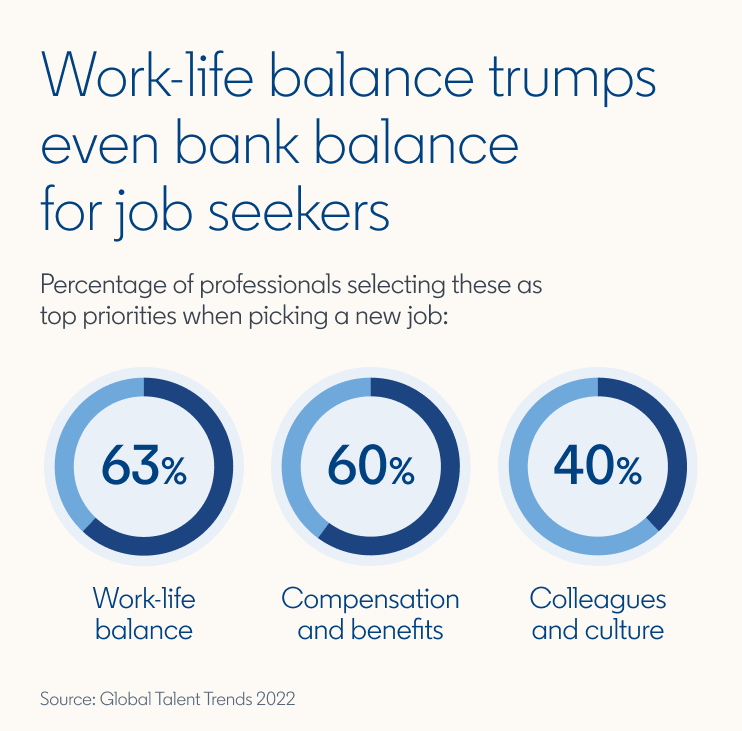
The relationship between employers and employees has continued to evolve over the decades. Work-life balance, the very fabric of corporate culture has continued to change.
For example, in the 1950s companies were strict hierarchies. Large corner offices were reserved for bosses, and the rest were in the middle of the office in the bullpen. The women were a small portion of the workforce and were often regulated to low-level positions.
In the 1970s women began to rise in importance in the workplace. Many social issues such as anti-discrimination, the hippie culture, women wearing pants, and birth control. Also, increased management opportunities once closed to women were now starting to open.
Then, in the 1990s lifetime employment ended. Employee lay-offs also became commonplace. Job security for the individual became more important than loyalty to the company. Companies began to cut costs and move production overseas. For example, all of Nike’s production was overseas.
In the 2000s, startups in technology were the new trend. Google redefined the definition of the corporate culture. While lifetime employment is a thing of the past, employment where creativity, freedom of work schedule, and open office spaces were in style. It became okay to have fun at work.
Now, let’s jump ahead to today. Workers are now re-evaluating what matters most to them in the wake of the COVID-19 pandemic, prompting employers to focus on the well-being and personal satisfaction of their employees.
Thus, employers are adjusting their policies to ensure that employees feel cared about as human beings, not just as workers, making flexible work arrangements permanent, investing in wellness programs, and boosting their diversity and inclusion efforts. Employers and employees are building a new, more dynamic relationship based on trust and empathy.”
For 2022 and beyond there are three areas of the corporate culture that needs our attention. The first is “Flexibility.” The second is “Well-being.” The third is “The Great Reshuffle.”
As we enter our third year of the pandemic, flexibility in our approach to various problems has become routine. While HR used to follow a one-size-fits-all approach, that’s not so true now. Listening and developing programs around the needs of the individuals are the way forward.
Even the word flexibility is being reconsidered. For example, Jessica DeGroot, founder and president of the ThirdPath Institute, prefers the term "strategic flexibility." She views the issue holistically: Strategic flexibility is workplace flexibility for men and women, from entry-level to executive leadership positions, that takes into account whether they work better onsite or offsite. She also includes life stages, recognizing that employees' needs change.
Also, the employees of today not only need change, but they want to change. "People want more flexibility...we understand that is the new normal," said Vinita Clements, chief human resources officer at Nationwide. "We've had to balance the needs of our associates and their desires and also understand the needs of our customers and how do we deliver on the promise to protect people, businesses, and futures?" Governments are also looking at greater flexibility.
For example, New Zealand’s and Finland’s prime ministers have floated the idea of a four-day workweek. Also, Britain’s Labour Party in 2019 campaigned on the idea that workweeks would be shortened in the next decade. Last year, Japan's annual economic policy guidelines revealed the country would encourage employers to adopt four-day workweeks.
Panasonic is reportedly introducing an optional four-day workweek for employees, allowing its workers to spend less time working and more time enjoying being alive. They will offer its workers a third day off per week. Panasonic CEO Kusumi Yuki noted they may opt to further their studies, volunteer, or even work a side job. "We must support the wellbeing of our employees," said Kusumi, as reported by Nikkei Asia.
Three-quarters of UK workers now say work-life balance is more important to them than it was pre-pandemic, and employers are starting to respond to this. The number of jobs advertised as remote has increased by roughly 20% since 2020, as demand increases, and both companies and staff alike have begun to understand that wanting to work flexibly is not necessarily negative or due to a lack of commitment. For many workers, it’s become about how their career fits with their lifestyle – it’s a ‘want’ rather than a ‘need’ that can help increase their quality of life.
The future well-being of our employees is hinged on the flexibility of our corporate culture. This brings us to our second corporate culture point of focus area for 2022 and beyond, “well-being.
Many companies have already expanded the wellness support they provide to their employees in the wake of this pandemic. A Gartner 2020 survey of 52 HR executives found that:
These programs work for those that take advantage of them. Gartner's analysis shows that employees who utilize these benefits report 23% higher levels of mental health, 17% higher levels of physical health, and are 23% more likely to say they sleep well at night. These improvements in personal outcomes translate to higher levels of performance and retention.
Also, the shift to remote and hybrid work is impacting recruitment. For example, removing geographic constraints opens the talent pool and creates more access to talent and that’s having a positive impact on hiring.
Flexibility around how, where, and when people work is no longer a differentiator. Employers that don’t offer flexibility will see increased turnover as employees move to roles that offer a value proposition that better aligns with their desires. This translates to employees calculating the well-being factor associated with the job and organization.
The future well-being of employees is hinged on the flexibility of the corporate culture. This brings us to our third corporate culture point of focus area for 2022 and beyond, “The Great Reshuffle.”
During this pandemic, businesses have faced many challenges. Some have said that the new normal is actually "The Great Reset." Others have written at great length this past year (me included) about, "The Great Resignation." And now, Mohan Nair of Forbes says that soon we will be calling it, "The Great Reshuffle."
Whatever you call it — resetting, resigning, or reshuffling — people have been updating their priorities and to-do lists. Here is the list Mr. Nair compiled from interviews with many CEOs of the most common priorities.
1. Supply chain disruptions and delays.
2. Employees not interested in working full time and looking for flexible hours.
3. Employees resigning outright.
4. Possible wars caused among customers and employees.
5. Mental health issues among family members and others.
6. The impacts of inflation on the cost of service or product.
7. Just plain tired of "Zooming" all day without really capturing the imagination of customers and employees.
8. People are unable to keep up with increasing demands.
9. Partners selling off their businesses or leaving their business altogether due to downturn.
10. Customers demanding new, improved, and even transformative services and products with giant, established competitors already taking a big share.
We can't live in anticipatory anxiety of what’s coming at us next. I suggest that we consider The Top Three Corporate-Culture Focus Areas for 2022 and Beyond, that we have covered in this blog and make that our agenda. In conclusion, everyone is looking for stronger company culture. How are you redesigning or modifying your corporate culture? I would love to hear from you.
Why Ethical Behavior is More Profitable and Energizes Employee Engagement
How To Win The War For Talent By Skills-Based Hiring
How To Combat the Great Resignation and Win the Battle for Talent
How An Improvement Strategy Is More Successful Than Goal Design
4 min readLeaders who act unethical and dishonest are destined for failure. Some of these leaders in their zeal for sales believe that “failure is not an option”. Furthermore, they do whatever it takes to win sales. And to them, “winning at any cost” is justified.
However, consider the destruction that the “win at any cost” attitude did to corporate giants Volkswagen, GM, Enron, Wells Fargo, and most recently Theranos. Those corporate giants lost their focus and turned a blind eye to unethical and dishonest practices.
Therefore, they lost profit and the confidence of many of their employees and consumers. There is probably no way to calculate the full loss of profit. Nor the degree of employee engagement lost that occurred from their unethical and dishonest actions.
I first experienced How Ethical Behavior is More Profitable and Energizes Employee Engagement in my youth. For instance, the values of honesty and ethical behavior were prevalent in my hometown. And practically everyone in my hometown left their homes and car doors unlocked. High values and ethical practices were the fabric of my hometown society.
This fabric was pieced together by trust and honesty, not fear. In addition, we also witnessed first-hand business leaders practice the values of honesty and ethical behavior.
For example, I remember asking our local banker if I could get a car loan. He said sure, if Hugh (my dad) says that you can have the loan, it’s yours. This example was probably the first time that I ever recognized the true value of a good reputation for ethical behavior. My dad was a good role model.
I have discovered a solution that leaders should consider. If they want to increase ethical behavior for greater profits and increase their employee engagement activity, they should consider these four insights. First, here is some research by Ethisphere Institute to consider.
What should leaders do? Ethisphere Institute conducted research in 2020 on ethical behavior and profitability. Similar profits or higher profits were achieved in ethical ran companies. 40 percent of the ethical companies achieved more than double the profits of their peers.
So, companies that practice ethical behavior are more likely to see increased profits. Dave Pickens, formerly president of Olive Garden Restaurants, said, "Culture is what guides behavior when no one is looking."
Also, consider what the common traits of great leaders might be. Rick Pitino, coach and author reminds us to “Look at the great leaders of history and one of the most common traits is integrity, believing and sticking to principles. From George Washington, whose famous saying is “I would never tell a lie,” to Franklin Roosevelt, who began one of his famous fireside chats by saying there is no good news to report this evening to Martin Luther King Jr., who marched through the South for his principles.”
Second, research-based organizations like Gallup indicate that engaged employees make a positive difference at work. So, employee engagement is good for the company and the employee. A busily engaged employee is a happy employee.
Third, we find additional proof from Dr. Jim Harter is Gallup's chief scientist of employee engagement and well-being. He makes the case that engaged employees are the most productive workers in a Gallup report "How Employee Engagement Drives Growth."
In 2020, Gallup conducted its tenth meta-analysis on the Q12 using 456 research studies across 276 organizations in 54 industries and 96 countries.
Finally, in 2020, Gallup conducted their 10th study of Gallup Q12 Meta-Analysis. Gallup researchers statistically calculated the business-work, unit-level relationship between employee engagement and performance outcomes. The researchers studied 112,312 business and work units that included 2,708,538 employees. They examined 11 effects:
According to Gallup, doing what is best for employees does not contradict what is best for the business or organization. There is a strong relationship between employee engagement and well-being. They came up with a formula of Per-Person Productivity = Talent x (Relationship + Right Expectation + Recognition/Reward.
Per-Person Productivity = Talent x (Relationship + Right Expectation + Recognition/Reward) Source: Gallup Q12 Meta-Analysis 2020
Consumers respond positively to companies perceived as ethical. From my own business experiences, I can prove that working with honorable clients is more rewarding. Peace of mind and greater profitability is the reward received by all stakeholders.
We need to continue setting ethical standards and implementing high values at home and work. Modeling this type of behavior will increase family ties, provide employees purpose and improve the financial health of our organizations.
Our financial health will be strong, as ethical behavior is more profitable. And such behavior energizes employee engagement. This behavior leads to increased transparency, honesty, and a culture of trust, not fear.
Now, what can you do? Or, what are you doing to improve ethical behavior and employee engagement in your organization? I would love to hear from you.
Here are some links to other recent blog posts.
How To Win The War For Talent By Skills-Based Hiring
How To Combat the Great Resignation and Win the Battle for Talent
How An Improvement Strategy Is More Successful Than Goal Design
How Career Maintenance is More Effective and Less Expensive Than Career Repair
4 min readIf you want to win the war for talent, skills-based hiring must be a part of your strategy. Judging talent by degrees alone is not enough.
Most hiring managers will start the hiring process by creating a job description. And the typical job description has limitations. Unfortunately, most JD's focus on educational expectations and industry-specific expertise only. Too often a hiring manager will exclude any potential candidate who cannot check both boxes. Little to nothing is mentioned about the skills required for the position.
Author Lou Adler suggests, “Most hiring problems can be eliminated by making one fundamental and simple change – replacing job descriptions with a list of performance objectives the new hire is expected to achieve.”
It's crucial to know the performance objectives of the role to make a successful hire. Is the objective a hire for a newly created position? Or, is it a replacement position? If this is a replacement position, how did the predecessor perform? If she was a good performer, benchmarking against her skill-set is one step towards defining the performance objectives for the position. By knowing the performance objectives, defining the skill set required for the role becomes more clear.
To win the war for talent, implement skills-based hiring. Too much weight on educational expectations is risky business. Some leaders believe we have degree inflation.
Harvard Business School conducted a study entitled, Dismissed by Degrees. They propose that there is a degree of inflation issue in the USA.
Harvard shares an example of administrative assistants and production supervisors. The study indicated that most people holding those jobs don't have a B.A. or B.S. Most new job postings for these positions list a bachelor's degree as a requirement. Such a degree requirement seems odd. Only 16% of current production supervisors have graduated from a four-year college, yet 67% of the openings for such positions call for a bachelor's degree.
There are many people who have had success without formal education. Actually, some very successful people never graduated from college. Some recognizable names are Steve Jobs, Michael Dell, and John D. Rockefeller. These example successful people focused on their skills and abilities. Degree or no degree, they have gotten things done and achieved. Many of these leaders have taken this belief of focusing on skills into their organizations.
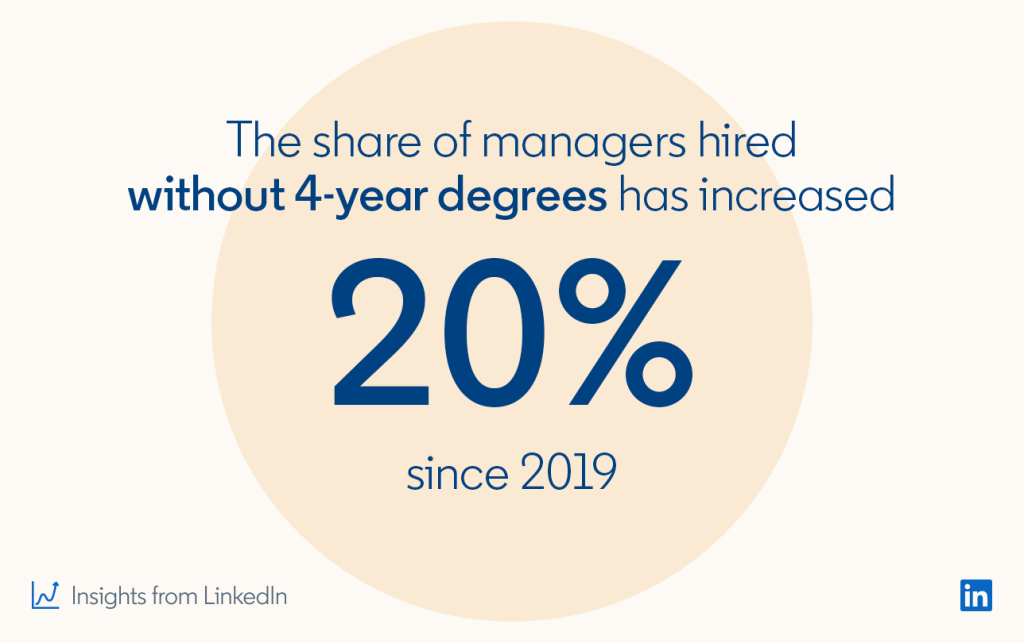
Some companies like IBM, Ernst & Young, Penguin Random House have made significant changes to their hiring policies. They are now hiring employees without college degrees. The share of managers hired without a 4-year degree has increased 20% since 2019.
With innovation, entrepreneurship, and significantly smarter fiscal policies, America should eventually escape its "hireless recovery." But what won't hasten new hiring — and might even dampen job prospects — is the mythical belief that higher education invariably leads to higher employment and better jobs. It doesn't. by Michael Schrage, Harvard Business Review
Once I put too much weight on a candidate's college degree. He had a degree in law and professional work experience from a competitor within the same industry. I did not assess his basic computer skills. Based on his law degree, I assumed his computing skills would be acceptable. This example was a pivot point for me many years ago. The pivot was to skills-based hiring.
One effective technique in skills-based hiring is the use of multiple interview-type questions. At McKinney Consulting we use multiple types of interview questions in our candidate assessment phase. Listed below are the six types of interview questions that we use the most. This is a sample list, not an exhaustive one.
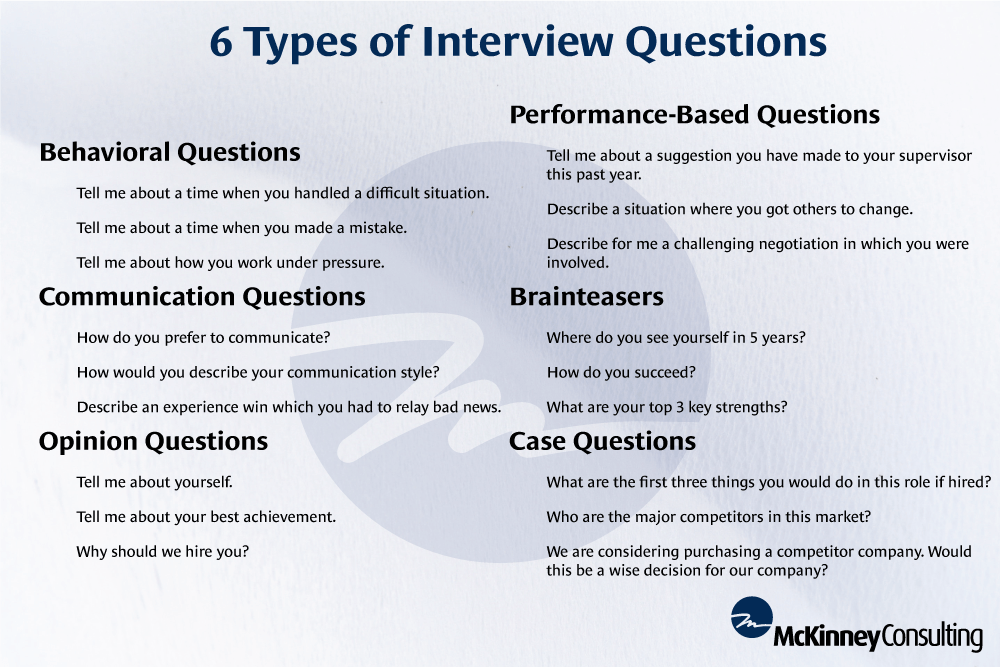
If in an interview your focus is adjusted beyond college degrees, you will widen the talent pool. A sharp focus on skills, abilities, and attitude has proven to be effective. Concentrating only on degrees could be problematic.
The risks are great if too much weight is placed on degrees. In South Korea, hiring decision-makers have learned the risks of hiring candidates based solely on their university degrees. The pressure to get accepted into the top 3 universities in Korea is fierce.
Most applicants' priorities are to get into the highest-ranked university possible. Their second priority is the field of study. This practice results in some graduates earning degrees in industries in which they have limited interest.
Don't get me wrong, higher education and a habit of continual learning are values that I subscribe to. Organizations need to ask the question of interviewees, what can you do for me today? How do those facts assure me that you can deliver what I need today? Skills-based hiring focuses on what you can do. If you want to win the war for talent, you must consider Skills-Based Hiring. Ignore skills-based hiring at your peril.
How To Combat the Great Resignation and Win the Battle for Talent
How Career Maintenance is More Effective and Less Expensive Than Career Repair
How Will a Hybrid Workforce Impact Your Culture?
The Soft Skills Required in a Hybrid Workforce
5 min readDuring this COVID-19 period, everyone’s life has been affected in many ways. Employers and employees alike have modified their work routines. This adjustment has not come from desire somewhat out of necessity. If that is not enough to rock our world, we see the “Great Resignation” occurring.
What’s going on? I propose that the "Great Resignation" is a pivot point where job seekers and employers are adjusting to a new world of work and life balance. Many see this as a time to reprioritize and reorganize how they approach life and work.
In my small hometown of Boone, North Carolina, real estate activity has been at a historic high. Nestled in the beautiful Blue Ridge Mountains, people flock to the mountains, looking for a better life and work from home.
Perhaps we are at a pivot point in time. I will make suggestions and draw some solutions on five specific issues.
The first issue is that we need to improve our soft skills in the new hybrid workforce. Digital transformation has already arrived at lightning speed. We use the latest and greatest communication tools such as Zoom, Teams, Skype, and others.
In addition, how we interact with each other in person and online is changing. Being sensitive and having empathy for the needs of our teams' members are not optional. There used to be a feeling that an employee's problems at home were theirs alone.
The solution is more employee education on these high-tech tools. Also, digitalization integration must consider work from home and the office. In my recent article titled, The Soft Skills Required in a Hybrid Workplace, I expand further on solutions to this problem.
The workplace is now at the corporate office and the home office in most companies. We can no longer ignore the challenges employees face at home. If the employee's challenges affect their work output, employers must make an effort to help.
One comprehensive solution is recognizing the hybrid workforce's effect on your corporate culture. In another article titled How Will a Hybrid Workforce Impact Your Corporate Culture? I outline seven areas to develop action steps around. These are:
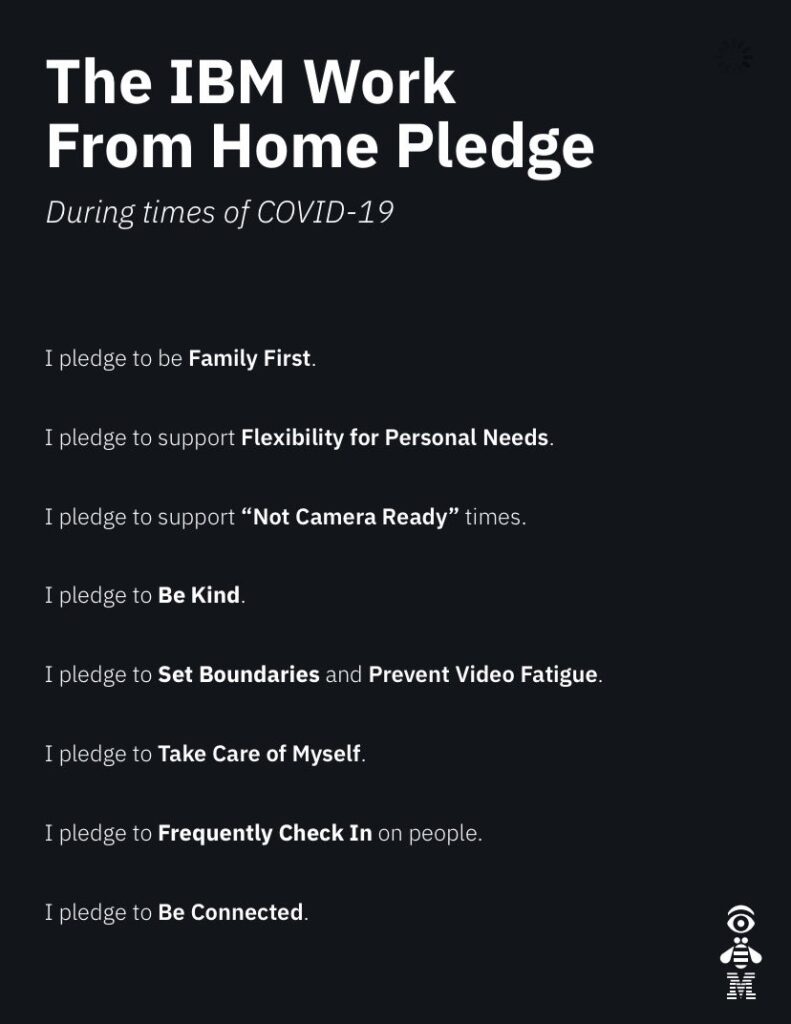
“We came up with what was called the Work from Home Pledge,” says Nickle LaMoreaux, the CHRO at IBM, “and it was how IBMers agreed to interact with one another while we’re all working from home.” It also was a major step in the company’s efforts to help their employees attain work-life balance. The pledge consists of eight individual vows that range from how employees will treat each other (with kindness) to how they will practice self-care (by setting boundaries).
Most people now face back-to-back Zoom calls versus back-to-back face-to-face meetings. They have too many interruptions even when working from home. On meeting interruptions, check out Microsoft's interesting Tweet. In jest, but there is usually a measure of truth in humor.
I have read from multiple sources that middle managers and upper management spend 35% to 50% of their time in meetings. This past month, I spent 25% of my time in meetings. I guess that I am doing okay.
Furthermore, a 2017 study led by Harvard Business School professor Leslie Perlow reported that 71% of senior executives say that meetings are unproductive and inefficient.
Just how much time should we be spending in meetings? With unique technology, you would think we could spend less time. Do you remember Tim Ferris's book, The 4-Hour Workweek?
We should re-read Tim's book. He showed research back in 2009 that 83% of employees then favored a shortened workweek. Interestingly, on July 27, 2021, Representative Mark Takano of California introduced legislation to reduce the standard workweek from 40 to 32 hours.
This point is all about Recruiting and Retention. It seems like everything is changing on how companies recruit and retain employees. For example, when an executive search firm has a middle-level placement, historically, the client typically would have 2 to 3 levels of interviews.
The first level would be an HR professional, and the second usually is the line manager. Then, there would be one higher-level person whose purpose is to support the hiring decision. However, HR leaders are adding more interview meetings to the hiring process.
The increased number of interviews puts added stress on the search firm, the candidates, and the hiring organization. I propose that the result is not necessarily better. HR's added number of interviews could be counterproductive. Most highly qualified candidates have multiple options on the table.
The job market is heating up, so there is more competition for extraordinary talent. Getting time off for one interview is tricky. Getting off for four is almost impossible if the candidate is fully employed.
Surprisingly, data shows that there is a shortage of recruiters. LinkedIn posted that there are more recruiter jobs open now than engineers globally.
Retaining employees has also become more challenging. The nature of work is changing. Instead of evaluating employees on their education and job titles, leaders now need to focus on skills.
The employees to choose from internally may lack the skillsets for the new job requirements. One client recently needed six highly qualified consultants for a global luxury automobile project. His only viable solution was to hire away 90% of a competitor's workforce at a premium cost.
Adjusting the work hours, workplace, and work requirements are necessary for this new hybrid workforce era. Continual coaching and training in-house talent is essential to retain great employees.
Finally, our personal development coaching programs help individuals reach their full potential in life and work if they need additional assistance. Reach out to us. We would love to hear from you.
Here are links to some other interesting blog posts.
How Career Maintenance is More Effective and Less Expensive Than Career Repair
How Will a Hybrid Workforce Impact Your Culture?
The Soft Skills Required in a Hybrid Workforce
How To Increase Intrapersonal Self-Awareness Success?
4 min readDuring college I spent 4 to 5 hours a day singing, honing my craft. I studied history, learned theory, and practiced vocal skills.
My music knowledge and abilities were constantly being evaluated by my professors. Incremental improvements were required of me to maintain college enrollment and keep my full music scholarship. This music study taught me a system that allows me to learn music quickly and perform at a professional level continuously.
This was the first time for me to be led by an improvement strategy system that encouraged incremental improvement.
In my previous life as Head of Footwear Product Development for Adidas International, incremental, and constant improvements were woven into our DNA with every action that we took. We developed 100’s of new creations every quarter.
Some designs were evolutionary with minor adjustments to existing designs. Other creations were totally new technology and materials with fresh design lines. This Adidas leadership experience is an early example of where I applied an improvement strategy system that encouraged incremental improvement gains.
In 2003, British cycling was simply terrible. The UK team was so bad that one bicycle manufacturer refused to sell them gear. Then, something miraculous happened with the cycling team.
The team hired a new coach, in Sir Dave Brailsford. Previous coaches implemented goals and guaranteed success. However, they all failed to deliver the goods. This new coach was different. He did not come in with goals and promises of success.
Sir Brailsford instead committed to a strategy he referred to as "the aggregation of marginal gains." Brailsford said, “The whole principle came from the idea that if you broke down everything you could think of that goes into riding a bike and then improve it by 1 percent, you will get a significant increase when you put them all together.”
By doing simple 1 percent improvements, remarkable things can happen. It is not the goal. It is the system that matters most. Implementing the aggregation of marginal gains system into British Cycling was a game-changer. Check out their change in fate and their accomplishments over the past 2 decades.
The Tour de France is the toughest competitive cycling event. It is a 21-day race that is exhausting and takes all the strength and stamina these athletes can muster. Since it is a 21-day event, this means that they must sleep in 21-different hotels.
Everyone knows that proper rest is paramount to peak performance. The coach did not want to leave anything to chance. So, Brailsford carried on the team bus, custom-designed mattresses, and pillows for each rider. This allowed each rider to the best quality of rest each night.
While this single detail made not sound like much but making little adjustments every day add up to significant improvements. The little things do matter.
Brailsford said in a 2015 interview with Harvard Business Review. “Perhaps the most powerful benefit is that it creates a contagious enthusiasm. Everyone starts looking for ways to improve. There’s something inherently rewarding about identifying marginal gains — the bonhomie is similar to a scavenger hunt.”
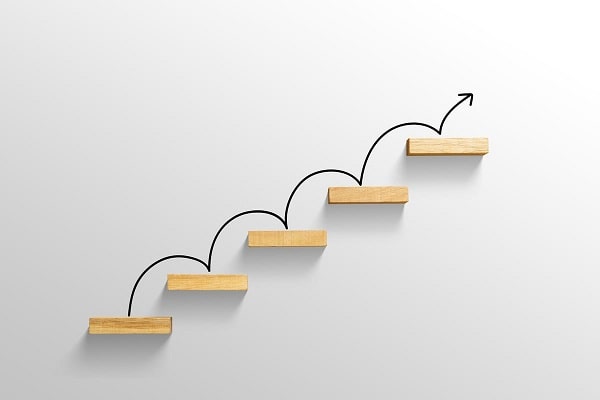
Briefly we coach individuals and teams on a new way to set their goals. Our system consists of three parts. We call these parts, Process Goals, Product Goals, and the Ultimate Goal.
The daily tasks we call Process Goals. These goals are the things that we spend our time on every day. It could be creating marketing content, e-mailing potential new clients, or attending networking events.
By doing targeted Process Goals, we can create the Product Goals that our client wants. These Product Goals are the different services we provide or the several types of widgets we have for sale.
Finally, we come to our Ultimate Goal. This is usually a single annual sales figure or a specific number of widgets that we want to sell that year.
Our daily tasks do matter. It is where we spend most of our time. And it is where we can make the most improvement. I propose that those who incorporate “aggregation of marginal gains system” into their organizations will see amazing results.
"What's the ONE Thing I can do, such that by doing it, everything else will be easier or unnecessary?"
Where should one begin to implement “aggregation of marginal goals system” into their companies? Here’s one idea. Gary Keller in his book, The ONE Thing proposes, "What's the ONE Thing I can do, such that by doing it, everything else will be easier or unnecessary?"
Think about that for a minute. What’s the ONE Thing that you could do in your organization? It will be different for everyone. Gary further believes that success is found in doing what matters most. That’s where you should start.
Personally, I have the desire to write more blog articles. To accomplish this, I have decided to do one thing. I will make a habit of writing every day. Author James Clear advocates that the way to build habits is to try and get just one percent better each day. There is that one percent idea again.
If I write every day, I should improve my writing skills. I would like to express principles that I coach more simply. Albert Einstein said, “If you can’t explain it to a six-year-old, you don’t understand it yourself.”
If you need additional assistance, our personal development coaching programs help individuals reach their full potential in life and work. Reach out to us.
Here are links to other blog posts that you might have interest in.
How Career Maintenance is More Effective and Less Expensive Than Career Repair
How Will a Hybrid Workforce Impact Your Culture?
The Soft Skills Required in a Hybrid Workforce
How To Increase Intrapersonal Self-Awareness Success?
4 min readBy adding career maintenance activities to your routine, you will become more effective and minimize the risks associated with career repair. Having coached and placed 100’s of middle to senior-level people in multinational companies over 20 years, I have witnessed patterns of success and failure.
Career maintenance success does not happen on its own. It must be taught and learned. On average, people within OECD countries go through about 17 years of education. This is based on the number of people between the ages of 5 and 39 currently in school. Yet, there are few courses on how to manage a career effectively.
For example, to learn, one must be humble and accept that there could be a better way. I have encountered some people who are not teachable or coachable. These people usually have a fixed mindset versus a growth mindset.
Also, according to author Carol Dweck, “In a fixed mindset, people believe their basic qualities, like their intelligence or talent, are simply fixed traits. Alternatively, “In a growth mindset, people believe that their most basic abilities can be developed through dedication and hard work. Brains and talent are just the starting point.
I agree that ”basic abilities can be developed through dedication and hard work.” Having earned a degree in music, I was trained to be a professional singer and conductor. Through further hard work, I developed the skills to manage a sizable athletic footwear production facility of 5,000 employees for Reebok and then become the Head of Footwear Product Development for Adidas. Both companies are global footwear giants. This led me to establish a management consulting firm in a foreign land serving Fortune 100 clients and others over 20 years.
Being sensitive and flexible to changes in the new hybrid workplace is another requirement for career maintenance. Flexibility at work is the new norm. There is no one size fits all. Some organizations are focusing on corporate cultural change, others on flexible seating, and others hone their sights on remote work.
LinkedIn found that 87% of people would prefer to stay remote at least half of the time in a recent survey. 81% of executives are planning to update their workplace policies to offer greater flexibility. It’s also interesting to note is that from March 2020 to August 2021, LinkedIn has tracked an 8.5x increase in the number of remote jobs posted on its platform.
According to a new survey from the consulting and staffing agency Robert Half, 41% of managers in the US are allowing staff to set their own hours. This trend of increased remote jobs reminds us of another critical task in career maintenance, employability skills.
I believe the development of employability skills will improve your value and increase your chances of life-long employment and personal fulfillment. While the term employability skills have been around for years, it is more relevant today than ever before.
There was not a position where I knew what I was doing when I started the job in my career. In every case, I had to develop new skills and gain more knowledge and education to succeed.
In addition to technical knowledge and subject knowledge, employers often outline specific skill sets required for a given position. Relying on University degrees alone is not sufficient, nor adequate career maintenance now or in the future. That’s risky business.
Further research from LinkedIn supports my theory that more companies need to communicate the skill sets required for open positions. They report seeing over the past two years a 16% increase in job postings listing skills as opposed to education or experience requirements.
I believe on average most people achieve more than they get credit for. Most people don’t want to brag about themselves or their successes. So, they fail to communicate these important events to those who need to read, hear or learn of these achievements. This could be a fatal mistake.
The number one thing that you can start doing today for your career management is to start writing a daily journal. The problem that most people have with doing this is, they say, “I don’t know what to write.” Let me help you get started.
Start your daily journal by answering the same 3 to 4 questions every day. That is what you will write about. If you need a writing prompt to get you started, I suggest that you start with these sentences.
Examples:
1) What was the most important thing that I accomplished today?
2) Please describe something that you read today that was meaningful to you and why.
3) Then, describe what the number one task is that you plan to accomplish tomorrow.
It is proven that career maintenance is more effective and less expensive than having to repair your career. We believe that our personal development coaching programs help individuals reach their full potential in life and work.
Here are other blog posts that you might have interest in.
How Will a Hybrid Workforce Impact Your Culture