
The most dangerous moment in any crisis is not day 30. It’s hour 1.
In that first hour, leaders are tempted to do one of two things:
Both responses are costly. Research shows that organizations that respond quickly and clearly in a crisis are far more likely to maintain trust and recover faster than those that delay.
You don’t need to predict every twist of the crisis on day one. You just need a simple, repeatable playbook for the first 24 hours.
This is your agility test.
Across my executive search and coaching work, I’ve watched senior leaders under pressure in product failures, supply chain collapses, sudden resignations, cyber incidents, and public scandals.
The pattern is always the same:
Their teams feel the difference immediately. Studies of crisis leadership show that when leaders take structured, task‑oriented action early, clarifying priorities, stabilizing operations, and communicating what comes next, people perceive the environment as safer and engage more effectively in solving problems.
In other words, in a crisis, leadership “presence” isn’t about charisma. It’s about structure and humanity, delivered fast.
Let’s turn that into a 24‑hour playbook you can keep on your desk for the next shock—because there will be a next one.
Think in three phases: 1–2 hours, 2–6 hours, and 6–24 hours.
You won’t get everything right. But if you get these nine moves mostly right, you will stabilize the system enough to make better decisions on day two.
Your only job in the first two hours is to protect people, contain damage, and take charge—even if you don’t have all the answers.
You can fix processes later. You can’t undo harm.
Empirical work on crisis teams shows that nested decision loops—frontline data feeding into leadership, and leadership feeding clear decisions back—support faster, more coherent responses.
In a shock, ambiguity about “who is in charge” is like pouring fuel on the fire.
You won’t have perfect information, but you must align on “what we know for now”:
Write this on one page. It becomes your temporary “truth” that you will keep updating.
Once you’ve stopped the immediate bleeding, shift to stabilizing the system and shaping the narrative—for your people first.
Research consistently shows that the way leaders communicate in the first hours of a crisis shapes trust more than the incident itself.
Your people are asking three questions:
Your first internal message should:
Honest, empathetic communication—delivered consistently—is one of the strongest predictors of team morale and public perception in crisis.
You cannot fix everything in the first day. Leaders who try end up doing nothing well.
Evidence from crisis leadership in complex environments shows that short‑term planning, clarified objectives, and decisive problem‑solving are exactly the “initiating structure” behaviors that improve safety and performance under pressure.
Ask your crisis team:
Turn this into 3–5 concrete actions with owners and deadlines. This is where proactive agility starts to show up: not in predicting everything, but in prioritizing well under uncertainty.
Even in a crisis, leadership isn’t one‑way.
Studies of remote and crisis work find that leaders who demonstrate consideration, listen, acknowledge concerns, and remain emotionally aware mitigate negative impacts and keep people engaged.
So, alongside your clear direction, you also:
You’re not promising to fix everything instantly. You’re signaling: “We see you. We’re listening. Your input matters to how we respond.”
Now you move from “reaction” to “organized response.”
Depending on the crisis, this may include regulators, emergency services, suppliers, landlords, or community partners.
Effective crisis responses often involve coordination with external agencies and sharing situational reports so resources can be aligned and support can be mobilized.
You also need to decide:
Mixed messages create secondary crises.
In the moment, documentation can feel like bureaucracy. In reality, it’s your memory when things get chaotic.
Best‑practice crisis playbooks recommend logging key decisions, rationales, and communications from the first hours.
This serves three purposes:
Agile organizations don’t just “get through” crises. They mine them for design improvements.
Before the first 24 hours end, gather your crisis team again and ask:
Research on crisis decision‑making emphasizes scenario‑based thinking: build best‑, base‑, and worst‑case views, use the data you have, and be willing to adapt as new information emerges.
You don’t need a perfect long‑term plan, but you do need a credible, flexible outline that your people can see.
This is where you transition from “shock management” to “strategic recovery.”
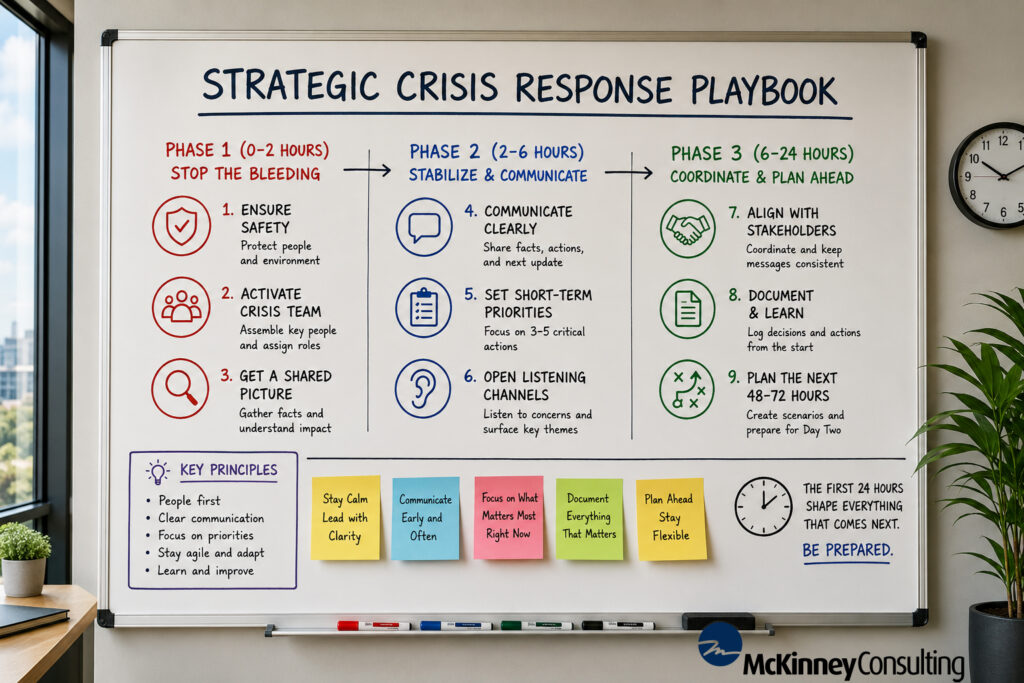
When I look at leaders who navigate crises well, they share a handful of habits that you can adopt before the next shock arrives:
That’s what I call Proactive Agility in crisis: not predicting the exact event, but designing your response capabilities in advance so that when the shock comes, you move with confidence instead of panic.
You can turn this newsletter into a practical asset for your organization in the next 30 minutes.
Here’s a simple exercise:
If you’d like a one‑page “First 24 Hours” checklist you can adapt and use with your team send me a direct message, I’m happy to share a version you can customize for your organization.
Because in a crisis, you don’t rise to the occasion. You fall to the level of your preparation.
2 min readWalk into any organization, sometimes even the most celebrated ones, and you can sense it almost instantly: teams operating in parallel universes, often just steps apart. Silos are not always visible, but they shape how decisions are made, how fast organizations move, and ultimately, how culture performs.
In my leadership roles with Adidas, Reebok, and later through McKinney Consulting, I’ve seen that silos are rarely born of poor intent. More often, they emerge from legacy structures, the speed of growth, or well-meaning leaders who reinforce “stay in your lane” thinking. Yet when this happens, creativity stalls, engagement drops, and the organization loses access to one of its greatest assets, its collective intelligence.
High-performing organizations are not immune to silos. In fact, their very success can reinforce them. When delivering on core goals, teams double down on efficiency and expertise, which strengthens internal alignment but weakens cross-functional curiosity.
During times of rapid change, these invisible walls often grow taller. Teams focus inward, protecting their priorities rather than exploring how their work connects to the broader enterprise. The result: fragmented execution and slower adaptation, two risks no leader can afford in today’s volatile environment.
Leaders who tolerate silos, consciously or not, end up managing the symptoms of separation:
At an executive level, these inefficiencies quietly drain strategic agility. In one client organization, for example, two country teams were solving identical talent challenges without knowing it, until a simple cross-functional forum revealed the overlap. Within weeks, they created a shared solution that saved months of effort and built alignment that endured far beyond the project.
Executives have a powerful role to play in shifting the question from “What’s best for my function?” to “What drives success for our enterprise?”
The most agile leaders don’t just break silos; they design connection into the organization’s DNA through these practices:
This week, try a simple experiment: bring two functional leaders together who rarely interact. Ask each what challenges they face that the other might help solve, or insights they’ve discovered that could benefit a different part of the business.
You’ll likely be surprised at how quickly mutual discovery generates momentum.
Because breaking down silos isn’t a policy, it’s a leadership behavior. When senior leaders demonstrate connection, the organization follows.
For today’s CHROs, CEOs, and business unit heads, the challenge isn’t just managing structure, it’s curating synergy. Building a culture that learns, collaborates, and iterates across boundaries is your greatest lever for sustainable performance.
The question is not if your organization has silos.
It’s how intentionally you’re dismantling them.
I’ve lost count of how many times I’ve seen brilliant people hold back or watched promising ideas fizzle, because no one wanted to risk getting it wrong.
I get it. Even in my own career, including my time leading teams at Adidas and Reebok, fear has cropped up in the quiet moments just before a big decision. That inner voice that whispers, “What if this doesn’t work?” can be powerful. It can slow your momentum, dull your instinct, and make you play smaller than you know you should.
But here’s the twist I’ve seen repeatedly: some of the most transformative advances, whether for individuals, teams, or entire companies, begin with a setback. What feels like failure in the moment often plants the seed for something far better.
Despite all the talk of innovation and agility, fear of failure still runs deep in organizations everywhere. Why? A few patterns come up consistently in my leadership conversations:
The paradox is that the same leaders trying hardest not to fail often end up limiting their greatest growth. When avoidance becomes a habit, creativity suffers, and teams stop asking, “What if we tried something different?”
Fear of failure doesn’t just stunt innovation; it subtly erodes confidence. Leaders who operate from fear tend to:
Over time, the organization becomes excellent at optimization but weak at imagination. That’s a dangerous place to be in a world moving faster than ever.
The most adaptive, forward-looking teams I’ve worked with share one essential trait: they treat failure as feedback, not final judgment. Here’s how they do it.
At McKinney Consulting, much of our work revolves around a principle we call Proactive Agility, the ability for leaders to anticipate, adapt, and act before circumstances force them to. But true agility depends on courage. If we fear failure, agility remains a slogan rather than a system.
The future belongs to leaders who can own their missteps, learn quickly, and keep moving. As one CEO client recently told me, “We stopped calling them mistakes. We call them early data points.” That mindset shift changes everything.
So, let me leave you with this question:
What’s one “failure” that ultimately led you—or your team—to a better outcome? Or perhaps, what’s one way you’ve helped your organization turn fear into focus?
In today's rapidly evolving business landscape, equipping your employees with the latest skills is no longer optional – it's essential for survival. Previously, we explored the importance of skills development in building a future-proof workforce. But simply offering training programs isn't enough. How do you know these programs are translating into real-world benefits for your organization? In this post, we will explore how to measure the impact of your skills development programs successfully.
Here's the challenge: Measuring skills development programs' return on investment (ROI) can be complex. Traditional metrics like cost per training hour tell a limited story. However, by focusing on the right data points, you can gain valuable insights into the effectiveness of your Learning and Development (L&D) initiatives.
A single metric rarely captures the full impact of an L&D program. Instead, a holistic approach that combines quantitative and qualitative data provides a more comprehensive view. Consider these key areas to measure the success of your programs:
Employee Engagement: High participation rates and positive feedback on training programs indicate employee buy-in and a willingness to learn. Beyond completion rates, consider conducting surveys or focus groups to gauge employee sentiment toward the training content and delivery methods.
Improved Job Performance: Did employees demonstrate improved skills or achieve better results after participating in training? Track key performance indicators (KPIs) relevant to their roles. This could include metrics like sales quotas achieved, number of errors reduced, or project completion rates.
The Retention Advantage: Investing in employee development demonstrates your commitment to their growth, fostering loyalty and potentially leading to higher employee satisfaction and reduced turnover. According to a 2021 LinkedIn study, companies with strong L&D programs experience a significant advantage, with 52% lower employee turnover than those with weak programs.
Customer Satisfaction Impact: Did improved employee skills translate into better customer service or product quality? Track customer satisfaction metrics like Net Promoter Score (NPS) or Customer Satisfaction (CSAT) scores to see if there's a correlation with implementing L&D initiatives.
Unlocking Cost Savings: L&D programs can offer unexpected cost savings. Consider the potential benefits, including:
Hilton Worldwide recognized the need to go beyond traditional metrics when measuring the impact of its L&D programs. They implemented a comprehensive tracking system that monitored key areas, including:
The results were impressive. Hilton found a strong correlation between employee participation in L&D programs and improved customer satisfaction scores. Additionally, they documented a 15% reduction in training time due to the effectiveness of their programs, signifying a direct cost saving.
While measuring the impact of L&D programs can be complex, it's crucial for demonstrating their value. Here's how to get started:
Implementing these strategies and focusing on the right metrics can demonstrate the true value of your skills development programs. A future-proof workforce equipped with the latest skills and a commitment to continuous learning is essential for navigating the challenges and opportunities that lie ahead.
Additional Resources:
The future of work is here, and it's changing faster than ever before. New technologies emerge alarmingly, customer demands evolve constantly, and work continuously transforms. To navigate these complexities and thrive in this ever-shifting landscape, organizations need a workforce equipped with the latest skills, adaptability, and resilience to keep pace with change. Building a future-proof workforce is more than just skills.
In today's competitive talent market, retaining skilled employees is a critical business concern. A 2023 LinkedIn survey revealed a staggering statistic: 72% of talent professionals report difficulty filling open positions due to a lack of qualified candidates. This talent shortage translates into a significant financial burden for organizations. The cost of replacing a lost employee can range from one-half to twice their annual salary, depending on the role and industry. These costs include recruiting, onboarding, and lost productivity during the transition.
So, what defines a future-proof employee? It's not just someone with a specific set of skills, although that's certainly important. A future-proof employee thrives within your organization, possesses a growth mindset, and is committed to continuous learning. They are adaptable and resilient, embracing change and navigating new challenges. They are also highly engaged and motivated, taking ownership of their work and contributing to the organization's success.
Building a strong employee experience (EX) is key to attracting and retaining top talent. A positive EX fosters a work environment where employees feel valued, motivated, and empowered to do their best work. According to a 2022 Gallup report, highly engaged employees are 21% more profitable, have 17% higher sales productivity, and are 12% less likely to leave their jobs. Here are some key elements that contribute to a strong employee experience:
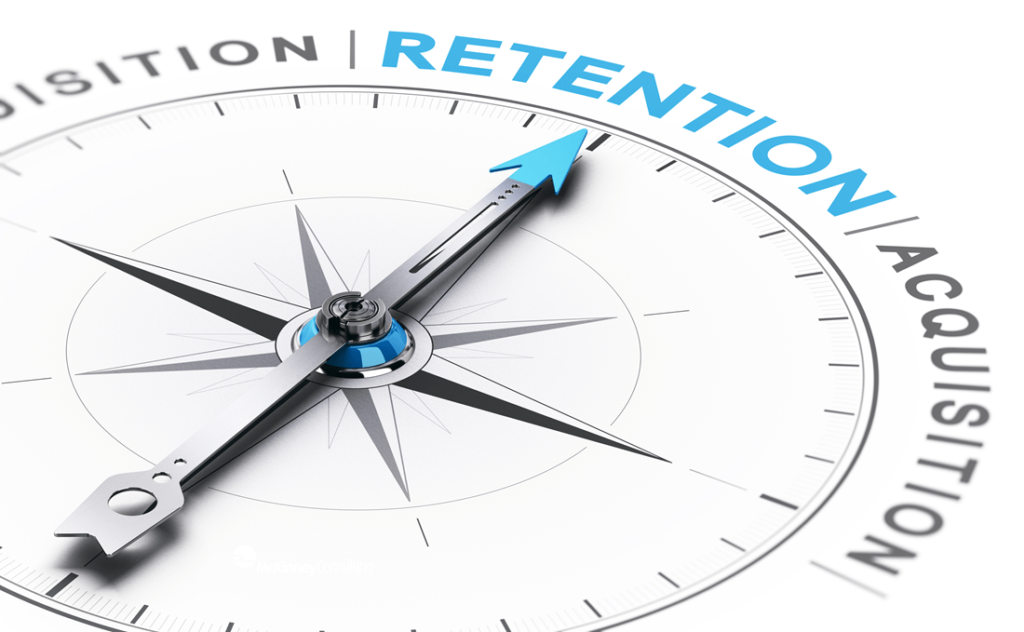
By offering a robust Learning and Development (L&D) program, you showcase your commitment to employee growth and foster a culture of continuous learning. L&D programs go beyond simply imparting technical skills; they can equip employees with the soft skills essential for future-proof success. These skills include critical thinking, problem-solving, communication, collaboration, and adaptability. Effective L&D programs empower employees to take ownership of their skill development and stay ahead of the curve in a rapidly changing world.
Investing in your skills development offers numerous advantages for employees, making them more valuable assets in the job market and fostering a sense of career ownership. Here are some key benefits:
Earlier in my career at Reebok International, I led a team in the athletic footwear division. We constantly pushed boundaries, designing and developing new technologies for global markets. Juggling international projects with tight deadlines was a daily challenge. Recognizing this, the company invested in our growth by sending us to a group coaching session in Hong Kong.
The focus of the session? Time management. While it might seem like a basic skill, the training was eye-opening. We learned practical strategies to prioritize tasks, delegate effectively, and avoid burnout. It wasn't just about ticking things off a list; it was about working smarter, not harder, to achieve our ambitious goals.
The impact was immediate. We returned with a renewed sense of focus and collaboration. We were able to manage our time more effectively, meet deadlines consistently, and even push the boundaries of innovation. This experience solidified my belief in the power of skills development – not just for individual growth but also for overall team success.
While measuring the precise ROI of L&D initiatives can be challenging, tracking key metrics can provide valuable insights. Consider tracking metrics like employee engagement in training, improved job performance after training completion, and retention rates.
Building a future-proof workforce requires a holistic approach. Invest in a robust L&D program and initiatives cultivating a positive employee experience.
By prioritizing skills development and employee well-being, you can build a resilient and adaptable workforce ready to thrive in the ever-evolving world of work.
4 min readHave you ever witnessed a choir performance where something unexpected happens? Maybe a soloist forgets their lyrics, or a technical glitch disrupts the sound system. I can tell you firsthand the chaos that can erupt! During a performance with my college choir, at Carnegie Hall in New York City, one of our members unfortunately got sick and…well, let's just say things got messy. But the truly remarkable performances are the ones where the choir adapts seamlessly. We recovered from the unexpected, adjusted our harmonies as best we could, and delivered a (mostly) beautiful performance. These moments highlight the crucial skills of leading with agility and adaptability, qualities just as essential in the world of business leadership.
This ability to adapt and thrive in the face of unforeseen circumstances is exactly what agile leadership is all about. Just like a choir conductor needs to be flexible and responsive, today's business leaders must be agile and adaptable to navigate the ever-changing world of work.
Recently, I spoke about agility and adaptability in Yahoo News and the International Business Times. We discussed the growing importance of agility in leadership. The truth is factors like the COVID-19 pandemic and the rise of AI have fundamentally shifted the business landscape. Remote workforces, digital disruption, and constantly evolving customer needs all demand a new kind of leader – one who can adjust strategies, embrace change, and lead their teams through uncertainty.
Traditionally, leadership models often emphasized a more rigid, top-down approach. While setting a clear vision remains crucial, agile leadership recognizes that the ability to adapt that vision as circumstances evolve is equally important. Imagine a conductor clinging to a rigid tempo during a performance – the result would be jarring and disjointed. The magic happens when the conductor can adjust the tempo and interpretation based on the needs of the moment, while still maintaining the overall integrity of the piece.
Think of today's business environment as a complex and ever-evolving musical piece. New instruments (technologies) are constantly being introduced, while familiar melodies (business models) are reinterpreted. Leaders who cling rigidly to outdated scores are destined for a disharmonious performance.
The good news is that challenges often present hidden opportunities. Leading with agility allows you to:
Just like a choir achieves its best sound through a combination of individual talent and harmonious collaboration, agile leadership thrives on a similar blend of skills. Here are some key elements that contribute to the "harmony" of agile leadership:
The ability to lead with agility isn't just a fad; it's a critical skill for success in today's dynamic business environment. By fostering a culture of agility within your organization, you'll be better equipped to:
Leading with agility requires practice, just like mastering a complex choral piece. If you're looking to develop your agility as a leader, McKinney Consulting can help. We offer a variety of coaching and leadership development programs designed to equip you with the skills and mindset needed to navigate uncertainty and lead your team to success.
About Steve McKinney Steve McKinney is the President and Founder of McKinney Consulting. With over 25 years of experience working in the fast-paced world of business, Steve is passionate about helping leaders develop the skills they need to thrive in today's ever-changing environment. He is also a professionally trained singer and conductor, bringing a unique perspective to leadership development.
3 min readIn our previous article, "Listening With the Intent to Understand, Not Reply," we discussed the critical importance of active listening in effective communication. We learned how truly listening to others, rather than simply waiting our turn to speak, fosters trust, understanding, and collaboration. Beyond listening is the art of powerful responses.
But active listening is just one piece of the communication puzzle. After listening attentively, crafting a powerful response is equally important. Our responses can significantly impact the flow of communication, build relationships, and move ideas forward. A study by Harvard Business Review found that leaders who actively listen and respond thoughtfully are rated as 73% more effective by their teams.
I was eager to prove myself early in my career in a brainstorming session with senior colleagues. I listened intently as they shared ideas, but I was so focused on formulating my own brilliant contribution that I missed an opportunity to build upon theirs. When my turn came, I presented my idea, which felt disjointed from the overall conversation. The response was polite but lukewarm. Reflecting back, I realized that a more powerful response would have been to acknowledge their ideas, ask clarifying questions, and then build upon their thoughts with my own contribution.

A well-considered response can have a transformative effect on any conversation. It demonstrates that you were truly paying attention, fostering trust, and opening doors for collaboration. Conversely, poorly formulated responses can lead to misunderstandings, missed opportunities, and conflict. Imagine the difference between blurting out the first thing that comes to mind and responding thoughtfully.
Here are some key strategies to keep in mind when formulating powerful responses:

Let's look at some practical examples of how to craft powerful responses in different scenarios:
We can significantly enhance our communication skills by mastering the art of active listening and crafting powerful responses. Remember, communication is a two-way street. When we truly understand others and respond thoughtfully, we foster stronger relationships, build trust, and achieve better outcomes.
Crafting powerful responses can be challenging, especially when dealing with difficult emotions or time constraints. Here are some tips:
By consciously practicing these strategies and overcoming challenges, we can become more effective communicators in all aspects of our lives.
3 min readWarren Buffett famously said, "Successful people say no to almost everything." While it sounds counterintuitive, there's a powerful truth hidden within this seemingly simple statement. In this post, "The Power of "No": Why Saying No Can Fuel Your Success as a Leader," we'll delve into this powerful truth. Mastering the art of saying no becomes crucial for leaders seeking to maximize their impact and achieve their goals.
The constant pressure to be "on" and available can lead to a culture of overcommitment. Leaders who say yes to every request or opportunity often find themselves:
This challenge is particularly relevant in the executive search field. We at McKinsey Consulting receive a high volume of potential candidate applications. To ensure we deliver the best results for our clients, we strategically prioritize who we interview based on their specific needs and requirements.
Saying no to less-qualified candidates allows us to dedicate our time and resources to those with the highest potential for success in the targeted role. One of the ways that we accomplish this is by using multiple types of interview questions. Here are 6 Types of Interview Questions that you should consider incorporating into your hiring practice.
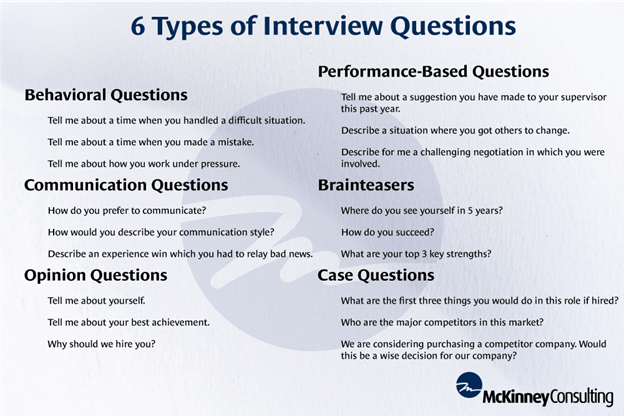
Saying no strategically isn't about shirking responsibility; it's about making conscious choices to optimize your time, energy, and impact. Here's how leaders can benefit from mastering the art of saying no:
Saying no effectively isn't about being negative or dismissive. It's about clear communication and setting healthy boundaries. Here are some tips for leaders to master the art of saying no:
By mastering the art of saying no, leaders empower themselves to make conscious choices about how they spend their time and energy. This strategic approach allows them to focus on the most impactful activities, fostering greater productivity, creativity, and well-being. Ultimately, saying no becomes a powerful tool that fuels success and empowers leaders to make a significant contribution to their organizations.
One effective way to win the war for talent is to use skills-based hiring. Check out our blog post, “How To Win The War For Talent By Skills Based Hiring.”
Helping You Become the Leader You're Meant to Be.
3 min readThe Great Resignation has fundamentally reshaped the talent acquisition landscape. As a result, today's top candidates, across all levels, have more choices than ever before. To stand out in this competitive market, building a strong employer brand is no longer optional – it's essential. Here's why: it allows you to attract the best and brightest leaders who can significantly impact your organization's success. This is where executive search firms can be valuable partners in winning the hearts and minds of top talent: the employer branding advantage.
Your employer brand is the overall perception of your company as a workplace. This perception encompasses everything from your company culture and values to employee benefits and career development opportunities. It's the story you tell the world about what it's like to work for your organization.

A strong employer brand offers a multitude of benefits, including:

Building a strong employer brand is an ongoing process that requires a multi-faceted approach. Here are some key strategies to consider:
Executive search firms bring a unique perspective and expertise to the table when it comes to building a strong employer brand. Their deep understanding of the talent market is key to winning the hearts and minds of top talent. Here are four ways executive search firms can help:
By partnering with an executive search firm, you gain access to a wealth of experience and resources. This partnership will help you build a magnetic employer brand that attracts top talent across all levels, especially the high-impact leaders you need to drive your organization's success.
Building a strong employer brand is an investment in your company's future. By focusing on these strategies and partnering with the right resources, you can create a work environment that attracts and retains top performers, propelling your organization to new heights.
5 min readImagine navigating a dense fog, visibility limited, the path ahead unclear. This, unfortunately, is the reality for executives today. From fluctuating economic data to ever-evolving technologies, the business landscape is uncertain, leaving even the most seasoned leaders feeling unmoored. The key is building resilience and adaptability in uncertain times.
But fear not, intrepid captains! Within this very uncertainty lies an opportunity. By cultivating resilience—the ability to bounce back from challenges—and embracing adaptability, we can weather the storm and appear more robust, innovative, and better equipped to lead our teams through uncharted waters.
In this newsletter, we will chart a course through these turbulent times. We will explore strategies for building mental fortitude, fostering emotional intelligence, and keeping physical well-being, all crucial components of a resilient leader. We'll delve into embracing change with an agile mindset, encouraging innovation, and making informed decisions even when the data seems murky.
So, join me on this journey as we equip ourselves with the tools and mindsets needed to survive and thrive in the face of uncertainty. Let's turn the fog into fertile ground for growth and transformation.

Leading in uncertain times requires more than just strategic acumen; it demands resilience: the ability to bounce back from adversity and appear more robust. Picture a bamboo tree, bending, not breaking, in the face of a storm. That's the essence of executive resilience. The key is building resilience and adaptability in uncertain times.
Building your mental fortitude:
Leaders like Winston Churchill Navigated the uncertainty of WWII with unwavering optimism and grit.
Uncertainty breeds stress and anxiety. High emotional intelligence (EQ) helps you manage these emotions and effectively lead others. High EQ helps us in building resilience and adaptability in uncertain times.
Leaders like Nelson Mandela Used his high EQ to unite a nation through empathy, forgiveness, and understanding.

Physical health directly affects mental well-being. Prioritize:
Explore resources: Apps like Calm offer sleep guidance, and nutrition websites like MyPlate provide healthy eating tips.
By investing in your mental, emotional, and physical well-being, you cultivate the resilience to navigate uncertainty confidently and lead your team toward success. This is just the beginning of our journey – stay tuned for more strategies for thriving in these ever-changing times!
Change is the only constant in life, and in today's business world, the dance floor is spinning faster than ever. But fret not, leaders! Here's where agility takes center stage.
Agility isn't just about being flexible; it's about embracing change as an opportunity. It's about ditching rigid routines and welcoming challenges as stepping stones to growth. Agile organizations:
To become an agile leader, cultivate a growth mindset. View challenges as learning opportunities and setbacks as fuel for innovation. Think Netflix, pivoting from DVDs to streaming, or Airbnb, disrupting the hospitality industry. These giants embraced change, leaving established players behind.
But agility isn't a solo performance. Foster a culture of innovation and experimentation. Encourage team members to:
Remember, a learning organization is an agile organization. Invest in:
Think Amazon, constantly testing innovative technologies and services, or Google, with its "20% time" dedicated to employee-driven innovation. These learning giants stay ahead by continually evolving.
Remember, change is inevitable, but your response isn't. By embracing agility, fostering innovation, and building a learning organization, you can transform challenges into opportunities for growth, propelling yourself and your team toward success in the ever-evolving dance of change.

Uncertainty can cloud judgment, making decisive action feel like groping in the dark. But fear not, intrepid leaders! You can illuminate the path forward by wielding data-driven decision-making tools and strategic foresight.
Data is your compass. Gather relevant information and use tools like data visualization and statistical analysis to understand what it's telling you. Intuition has its place but relies on data as your guiding star in uncertainty.
Embrace scenario planning. This isn't about predicting the future; it's about painting multiple "what-if" scenarios, allowing you to anticipate potential challenges and develop flexible response plans. Think chess, not fortune-telling.
Don't go alone. Seek diverse perspectives from stakeholders, experts, and your team. Encourage open communication and collaboration – a symphony of voices creates a richer understanding than a solo performance. Foster a culture of psychological safety where everyone feels comfortable sharing their opinions, even if they differ from yours.
Remember, making decisions in uncertain times isn't about absolute certainty; it's about mitigating risk and maximizing opportunity. By harnessing the power of data, strategic planning, and diverse perspectives, you can confidently navigate the fog, leading your team toward a brighter future.
We've explored the turbulent waters of uncertainty, equipping ourselves with the tools to navigate gracefully and determinedly. Remember:
Don't let uncertainty paralyze you. Let it be the catalyst for growth and transformation. Act:
Let's transform uncertainty into opportunity together, steering our teams towards a bright and prosperous future.